
Our farm yard, now to show you what you are seeing. We do not just call the building site "the farm" but consider a farm to be the buildings plus the land or in some cases just the land. Can’t have a farm without land or it is just not a farm. We own some farm land adjacent to and across the road from our farm yard but rent most of the ground we farm. OK, on to the detail photos; just keep reading and looking at the photos to find out what you are looking at. If you click on the photos you can get a larger view of each one.

Photo 1: The green circles the cattle – cows, calves and bulls. Some are in the lots but most of them are in the field west of our house. The horses are circled in red. One is in the pasture and I can see 3 in the lot. We have 5 horses and one is either in the barn or farther out in the pasture outside the photo.
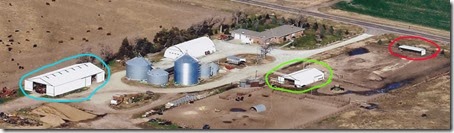
Photo 2: Green circles the barn where there are a few stalls for the horses or we can put a few cattle inside if needed. Red circles the open fronted shed for shelter of any animals in that north lot. The blue circles the Morton building that normally has machinery housed in it but if we are having really nasty weather during calving season a temporary ally is built from the cow lot to it and machines moved outside so we can bed the entire cow herd inside if needed. Freezing wet temperatures are not good for newborn calves. The cows are OK outside but a wet newborn can die in a short amount of time if it is really cold and add some wind , which we get a lot of here in Nebraska, and it becomes really dangerous for the calf. The cows get along fine if it is cold and wet and they will just have the calves outside if we don't lock them in so we have to put them in to protect the unborn calves. Cold is not as big a problem as wetness is as a cow has very thick skin and a hair coat that will insulate unless it gets really wet. It is funny to see cattle with a little snow on their backs after a storm and the snow hasn't melted. That shows how insulated they are.

Photo 3: The red outlines the lots we use for the cows when they are calving. There is a large lot clear on the south with an ally to a lot close to the barn where the water tank is located. The green outlines the pen where the year old weaned calves are right now. As you can see it is directly across the driveway from the house so we can keep a close eye on them. Not bad now but the first few days when they were away from their mothers it was really noisy with all the bawling. We also use this lot for the heifers we keep to become cows. These are part of the crop from this years calves and they will be sorted off before the rest go to auction. We can’t put them with the cows as they still remember their mothers and when that cow has a new calf all the milk needs to go to the new calf not the year old one that will push the small calf away. Besides that the bulls are still with the cows and these young heifers would get bred now and we want them to grow another 6 months before they are bred so they can be older when they have their first calf....easier on her and easier on us too! The blue circles the horse lot.

Photo 4: Red circles large round hay bales that get fed to the cattle or horses. Some of the hay bales are alfalfa for cattle and some are grass hay for the horses. Our grandkids love playing on these rows of hay bales. The bales look like fat tubes and are around 5 feet tall and about 6” long so are pretty big. The kids crawl up and run back and forth jumping between rows. At Christmas they played out there for hours playing tag and other games. Green circles the silage pile. This corn silage was chopped last fall and hauled in and piled and packed for feed. It will be fed to the cows when they are pulled off the stock fields the first of March and put in the lots during calving season. Blue circles the bale feeders. Some are individual feeders for one bale like the ones in the lots but others are trailers on wheels that hold several and can be pulled to which ever lot they are needed.

Photo 5: The green circles show where machinery is stored. John tries to keep a lot in the large Morton building but as you can see there is other machinery lined up in other places. We have tried to keep the old and worn out stuff cleaned up but it still looks like there might be more to cull.
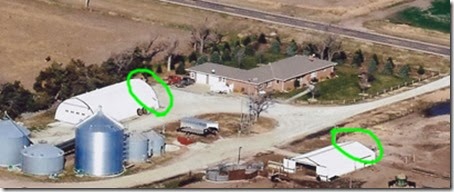
Photo 6: The green circles show where my barn quilts are located. Of course from this view to the north you can’t see them. You can read about how I made them and see what they look like
here.

Photo 7: A green circle encloses the grain storage bins we have on our farm. Bin #1 is the largest and holds 30,000 bu. Bin #2 is the drying bin that the grain goes through to be dried down to storing moisture content and it holds 8,000 bu. You can see the augers leading from it to bin #3 and #1 and as the grain is dried it is moved into the other bins until they are full then this one gets used for storage too. Bin #3 holds 24,000 bu. Bins #4 and #5 are small and we don’t really use them anymore and John would like to get rid of them at some point. We have the use of bins in a couple other places we farm too and any excess that can't be stored in one of these bins is hauled directly to the grain elevator at harvest.
Well that pretty much sums up the photo of our place. It is a great place to live and work and entertain. Now you can have a picture in your mind about where I live and if you happen to be driving by and recognize the place just stop in for a cup of tea.
Until Later,
Lynn


